
Establishment of Information Technology Business in Nepal by the Foreign Investor
1. Background for establishment of Information Technology Business in Nepal
Some of the reasons to establish an IT Business in Nepal are: a cost-effective workforce, untapped growth potential, outsourcing hub: leveraging cost-effective services, diversification of business operations, skilled workforce, growth potential, etc. Due to the mentioned advantage, a large number of IT Companies have already started their operation in Nepal.
Business structures for the foreign investors to do business in Nepal are either
(i) the establishment of a new local subsidiary company through foreign investment or investment in an already existing company,
(ii) registration of the branch office of the foreign entity in Nepal.
This article explains details regarding the viable options for foreign investors to establish the IT Business in Nepal.
2. Establishment of the new local subsidiary company through foreign investment.
2.1 Governing Laws:
The matters related to the establishment of the IT Business in Nepal by foreign investors are governed by (a) Foreign Investment and Technology Transfer Act, 2019 (“Foreign Investment Act”), (b) Industrial Enterprise Act, 2020 (“Industrial Enterprise Act”), (c) Foreign Exchange (Regulation) Act, 1962 (“Foreign Exchange Act”), and (d) The Companies Act, 2006 (“Companies Act”).
2.2 Permissibility:
One of the options available for foreign investors to operate an IT Business in Nepal is by establishing a subsidiary company through foreign investment in Nepal. For this option, a foreign company desirous to invest in Nepal must invest in a permitted sector of “industry” in Nepal. The permissibility of foreign investment in Nepal is subject to the fulfillment of the following two criteria:
- Firstly, the sector of industry must not fall under the “Negative List of Industries for Foreign Investment” provided in the Schedule of the Foreign Investment Act; and
- Secondly, the sector of business must fall under the classification of an “industry” under the Industrial Enterprise Act, which is also called “Positive List”.
The Industrial Enterprise Act enlists IT Business under the classification of Positive List, and the Foreign Investment Act does not include it under the Negative List. Thus, the Investor can apply for foreign investment approval to establish a company to operate an IT Business with 100% foreign ownership in equity shares of the company or in a joint venture (JV) with Nepalese/foreign investor/s.
2.3 Minimum Capital Requirement:
There is no such investment threshold for foreign investment for the Information, Communication, and Technology Services Business.
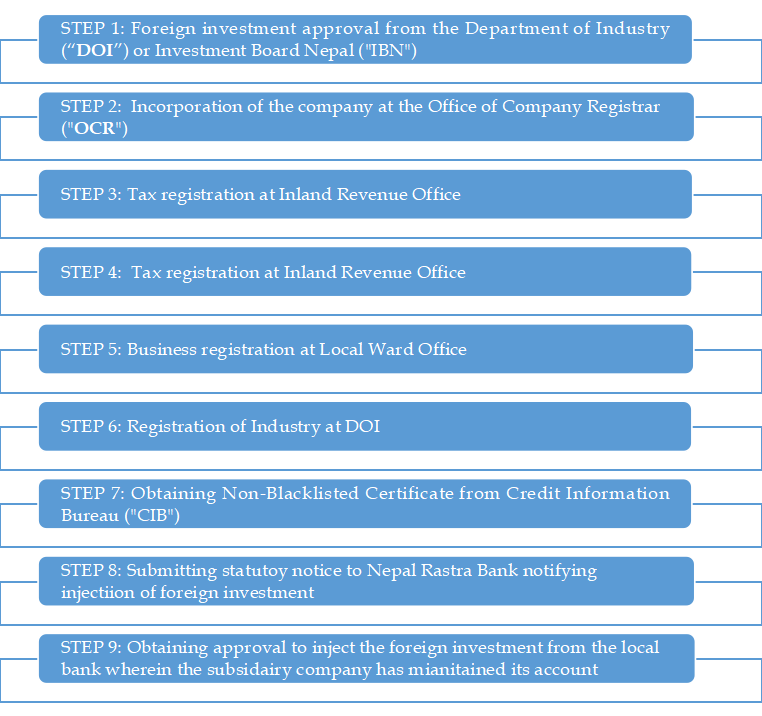
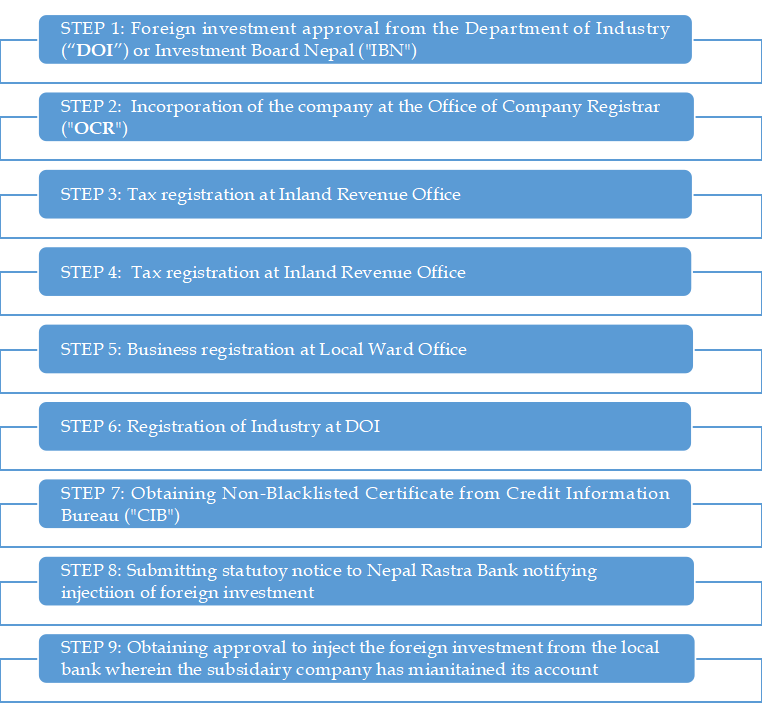
2.4 Procedure of establishment of local subsidiary company in Nepal:
Following steps are followed for registration of local subsidiary office:
2.5 Required documents:
The list of the documents required for foreign investor are as follows:
S.N. | Documents |
1. | Company incorporation certificate (if the company is an investor) |
2. | Memorandum of Association |
3. | Article of Association |
4. | Copy of passports of all the directors and shareholders of an investors |
5. | Copy of passport or citizenship of an investor’s authorized representative |
6. | Project Report and schedule for investment |
7. | Financial Credibility Certificate (“FCC”) |
8. | Latest financial statement |
9. | Board Resolution of the investor company (if the company is an investor) |
10. | Profile of the company or biodata of an individual investor |
11. | Power of attorney |
2.6 Timeline for incorporation of a subsidiary company
The overall time period for the registration of foreign direct investment in Nepal takes 2 weeks.
2.7 Timeline for injection of Foreign Investment amount
Foreign investors are required to bring the following percentage of the FDI amount within 1 (one) years from the date of DOI approval.
S.N. | FDI approval | % of Capital injection |
1. | NPR. 20 million (approx. USD. 150,000)
| 25% |
2. | NPR. 20 million to NPR. 250 Million (approx. USD. 150,000 to USD. 1.8 Million) | 15% |
3. | NPR. 250 Million to NPR 1 Billion (approx. USD. 1.8 Million to USD 8.5 Million ) | 10% |
4. | Above NPR. 1 Billion (approx. USD 8.5 Million)
| 5% |
Notwithstanding the above, FITTA Regulation requires investors to bring in 70% of the total FDI amount before commercial operation of the investee company, and the remaining 30% within 2 (two) years thereafter.
3. Registration of branch office
The second option for the Investor to establish an IT Business in Nepal is by establishing a branch office. The branch office can carry out the business activities that the Investor carries out in the country of its incorporation, as stated in the Memorandum of Association or related incorporation documents. Thus, the incorporation documents of the company issued from the home country must state the objective related to IT Business if it wants to carry out such activities in Nepal.
3.1 Governing Laws:
The registration of a branch office of a foreign company in Nepal is governed by the Companies Act, 2006 (2063) (“Companies Act”). Section 154 (1) of the Companies Act incorporates the provision related to the registration of a branch office of a foreign company in Nepal.
Approval from the relevant government authority must be obtained for registration of the branch office. For a branch office registration of an IT company, approval has to be obtained from the Ministry of Communication and Information Technology of the Government of Nepal.
3.2 Minimum Capital Requirement:
The minimum capital investment threshold does not apply to this option. It is free to transfer the operating costs into the local bank account as required for the branch office. However, the activities of making an investment in shares of any company, lending money to any company, or participating in the operation or management of such a company are not allowed.
3.3 Act that does not constitute an establishment of a branch office:
The establishment of business through equity investment and its management, engaging the agent or distributor in Nepal, would not be construed to have established a branch office in Nepal.
Also, the branch office establishment does not provide the legal status of a separate legal personality. It shall be considered as part of a foreign company operating in Nepal.
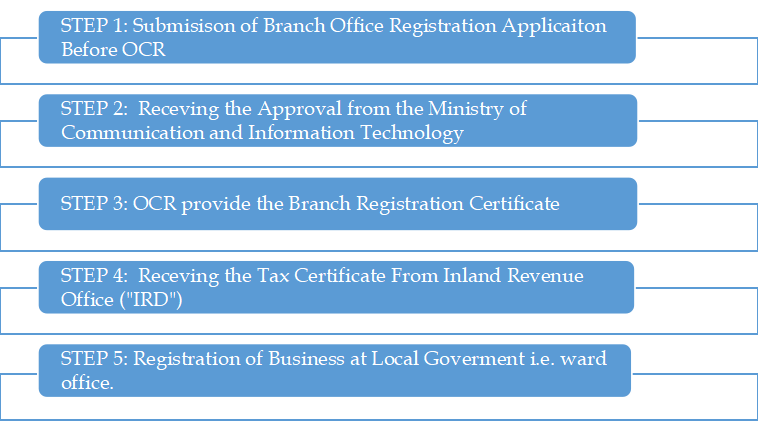
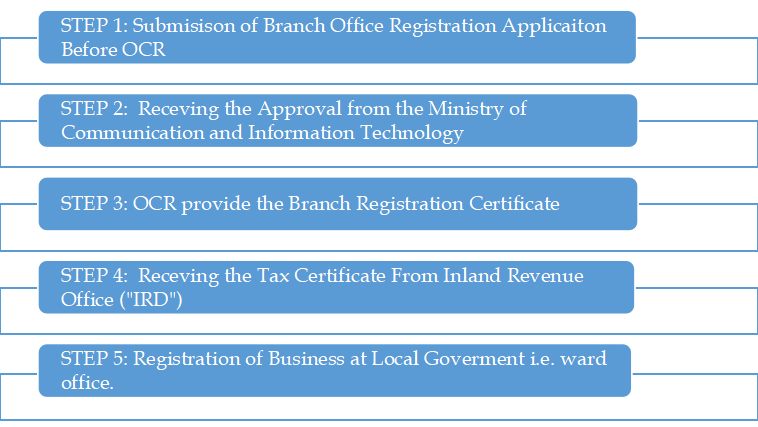
3.4 Procedure for establishment of the branch office
The following steps are followed for branch office registration:
Kindly Note:
Separate approval shall not be required if the foreign company has already executed the agreement with government authority.
3.5 Required documents:
The list of the documents required for the establishment of a branch office are as follows:
S.N. | Documents |
1. | Certificate of Registration, Memorandum of Association, Article of Association of the Foreign Company and its Nepalese Translation. |
2. | Application for Branch Office Registration |
3. | Board Resolution of the Foreign Company to set up a branch office. |
4. | Signed Copy of Company Profile |
5. | Copy of passport of all directors of Company |
6. | Copy of citizenship certificate of Nepal Representative authorized to receive notices |
7. | Letter of appointment of Authorized Representative |
8. | Proposed Plan of Branch Office |
9. | Power of Attorney. |
10. | Declaration of director or their representative of Company that the information submitted is correct and accurate |
11. | Approval letter from the Ministry of Communication and Information Technology |
12. | Agreement executed by the foreign company with the government authority of Nepal (if available) |
3.6 Timeline for completion of registration of branch office
The timeline for registration of a branch office in Nepal is usually 30 to 45 days. Sometimes it may require additional days to receive the approval from concerned government authority.
4. Classification of IT Business under Industrial Enterprises Act
IT business options permitted by Foreign Investment Act are:
i. Information Technology Industries
- Technology park;
- IT park;
- Biotech park;
- Software development;
- Computer and related services;
- Data processing;
- Cyber café;
- Digital mapping;
- Business process outsourcing (B.P.O), knowledge process outsourcing (K.P.O);
- Data center, data mining, cloud computing;
- Digital signature certifying agency;
- Web portal, web designing service, web hosting, online classified advertising
service
ii. Information Technology- based industries
- Internet service provider (ISP);
- Telephone, mobile phone, mobile satellite phone operator service;
- Teleport service;
- Establishment and operation of the satellite, the establishment of satellite
broadcasting center, VSAT service; - Broadband infrastructure, telecom tower, optical network, satellite network;
- Social networking, online messages, video calls, conferences.
iii. Dissemination Technology-Based Industries:
- FM radio, digital radio service;
- Digital land surface television, satellite television, cable television;
- IP television, online service;
- Digital cable television, network, direct-to-home (DTH) satellite service, MMDS
network, digital television (DTTV) network; - Recording studio, broadcasting studio;
- Print media industries, audio-visual material production industries,
advertisement production industries; - Production of motion pictures or documentaries.
5. Differences between establishing the subsidiary company and a branch office:
The following is a comparison chart outlining the differences between the provided options:
S.N. | Matter | Subsidiary Company | Branch office |
1. | Liability | The subsidiary company will be a private limited company with limited liability. | The work and liability of the branch office shall be directly attributable to the foreign registered company. |
2. | Share capital | The minimum amount of share capital for a local subsidiary company is NPR NPR. 20 million (Approx. USD 1,50,000). | No minimum threshold of capital amount to register the branch office in Nepal. |
4. | Repatriation facility | Pursuant to Section 20 of the Foreign Investment Act, a local subsidiary company has right to repatriate the following amounts back to the Investor’s country: · profits from business in Nepal; · amount received from the sale of shares with foreign investment; and · in case of liquidation or winding up of the industry or company, amount remaining after paying all liabilities following the liquidation or winding up. | Pursuant to Nepal Rastra Bank Foreign Investment and Loan Management By-Laws, 2021, a branch office can repatriate its profit by obtaining approval on the basis of necessary evidence and justification. However, the approval procedure is still new and largely depends on the discretion of the approving authorities. |
6. | Visa facility | Pursuant to Section 30 of Foreign Investment Act, the facility of following visas are provided to the Investor: · Business visa shall be granted to a foreign investor or one authorized representative of him or her and the family members of such an investor or representative to stay in Nepal until the foreign investment equal to such minimum amount as prescribed is maintained; · A non-tourist visa not exceeding 6 (six) months is provided to the Investor for the preliminary study of investment; and · Residential visa to the Investor who makes foreign investment in an amount exceeding USD 1 million or in convertible foreign currency equivalent thereto at one time. | Business visa and residential visa are not provided for foreign employees of the branch office. |
Frequently Asked Questions
Viable business structures permitted by Foreign Investment Act are:
i. Information Technology Industries
- Technology park;
- IT park;
- Biotech park;
- Software development;
- Computer and related services;
- Data processing;
- Cyber café;
- Digital mapping;
- Business process outsourcing (B.P.O), knowledge process
- outsourcing (K.P.O);
- Data centre, data mining, cloud computing;
- Digital signature certifying agency;
- Web portal, web designing service, web hosting, online classified advertising
service
ii. Information Technology- based industries
- Internet service provider (ISP);
- Telephone, mobile phone, mobile satellite phone operator service;
- Teleport service;
- Establishment and operation of satellite, establishment of satellite broadcasting
center, VSAT service; - Broadband infrastructure, telecom tower, optical network, satellite network;
- Social networking, online message, video call, conference.
iii. Dissemination Technology-Based Industries:
- FM radio, digital radio service;
- Digital land surface television, satellite television, cable television;
- IP television, online service;
- Digital cable television, network, direct to home (DTH) satellite service, MMDS
network, digital television (DTTV) network; - Recording studio, broadcasting studio;
- Print media industries, audio-visual material production industries,
advertisement production industries; - Production of motion pictures or documentaries.
Foreign investors are required to bring in the FDI amount within 1 (one) year form the date of DOI approval.
| S.N. | FDI approval | % of Capital injection |
| 1. | NPR. 20 million (approx. USD. 150,000) | 25% |
| 2. | NPR. 20 million to NPR. 250 Million (approx. USD. 150,000 to USD. 1.8 Million) | 15% |
| 3. | NPR. 250 Million to NPR 1 Billion (approx. USD. 1.8 Million to USD 8.5 Million ) | 10% |
| 4. | Above NPR. 1 Billion (approx. USD 8.5 Million) | 5% |
Not with standing the above, FITTA Regulation requires investors to bring in 70% of the total FDI amount before commercial operation of the investee company, and the remaining 30% within 2 (two) years thereafter.
The Foreign Investment Act grants following types of visa facilities to foreign investor:
- Non-tourist Visa:
In the initial phase, Foreign investor(s) (“Investor”) is granted a non-tourist visa by the Department of Immigration for a maximum period of 6 (six) months on the recommendation of the Department of Industry (“DOI”) to undertake a preliminary study of investment.
- Business Visa:
If the Investor is desirous to bring foreign investment in Nepal, a business visa is granted to the Investor or one authorized representative of him or her and the family members of such Investor or representative to stay in Nepal until the foreign investment equal to such minimum amount as prescribed is maintained pursuant to the Foreign Investment Act.
DOI will provide business visa recommendation for certain period depending upon the fulfillment of requirements of incorporation process. The requirements are set out below:
| S. N. | Period | Conditions for issuance |
| a. | For 3 months | Under the condition of submission of certificate of incorporation of company for next visa approval. |
| b. | For next 3 months | Submission of certificate of incorporation and under the condition of submission of documents of tax registration, bank account details, industry registration or details of industry registration progress for next visa approval. |
| c. | For next 6 months; or | Submission of industry registration certificate. |
| For next 3 months | Upon the satisfaction of industry registration progress and under the condition of registration of industry before injection of foreign investment capital for next visa approval. | |
| d. | Next visa approvals | Upon the injection of foreign investment capital. |
- Residential Visa:
DOI will recommend a residential visa if the Investor makes foreign investment in an amount exceeding USD 1 million or in convertible foreign currency equivalent thereto at one time.
- Unlike branch offices, liaison offices are not allowed to do any income-earning activities in Nepal. The liaison office can only be used as a contact point for the foreign company and other local parties to communicate, coordinate and regulate the relationship;
- As a matter of practice unlike branch office liaison offices are not required to take any approval from the concerned authority for establishment;
- Activities such as entering into a contract for transaction and marketing and advertisement of the product of the company is restricted for Liaison Office